AI systems
A storybook about anything she wants
My daughter loves stories. Every evening there's one more, and the story she wants is rarely the one we have on the shelf. It's about whatever she's thinking about that day.
Now I can give her exactly that story. I write down what she wants to talk about and who should be in it, and Čičamiča writes and illustrates a book where she's the hero. Then I can order it as a printed book for the shelf, or download the PDF and read it with her on the tablet. And sometimes we make one together: we go through the app on the tablet side by side, and she decides what goes in.
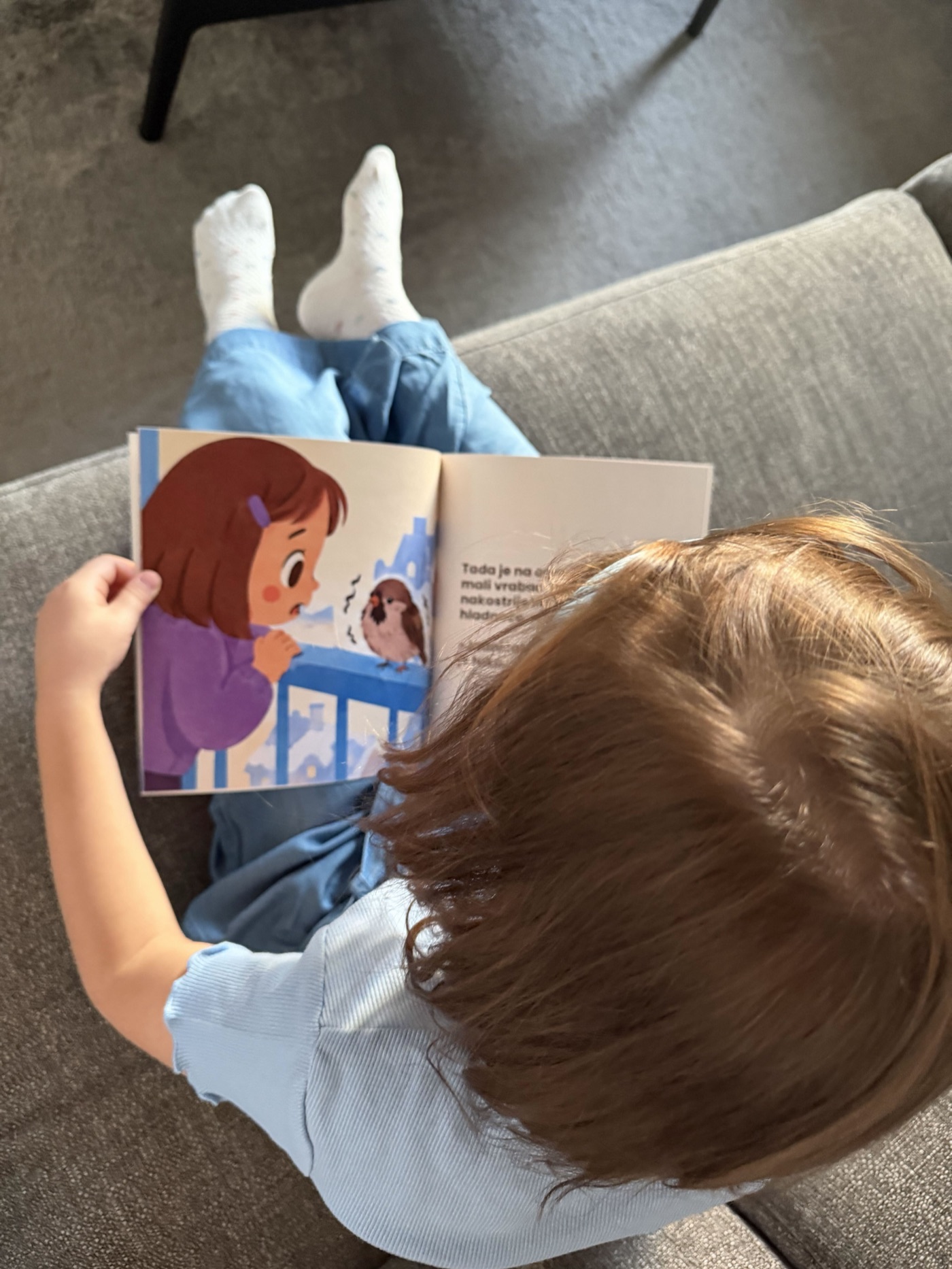
The one in the photo is about a little sparrow on her balcony.
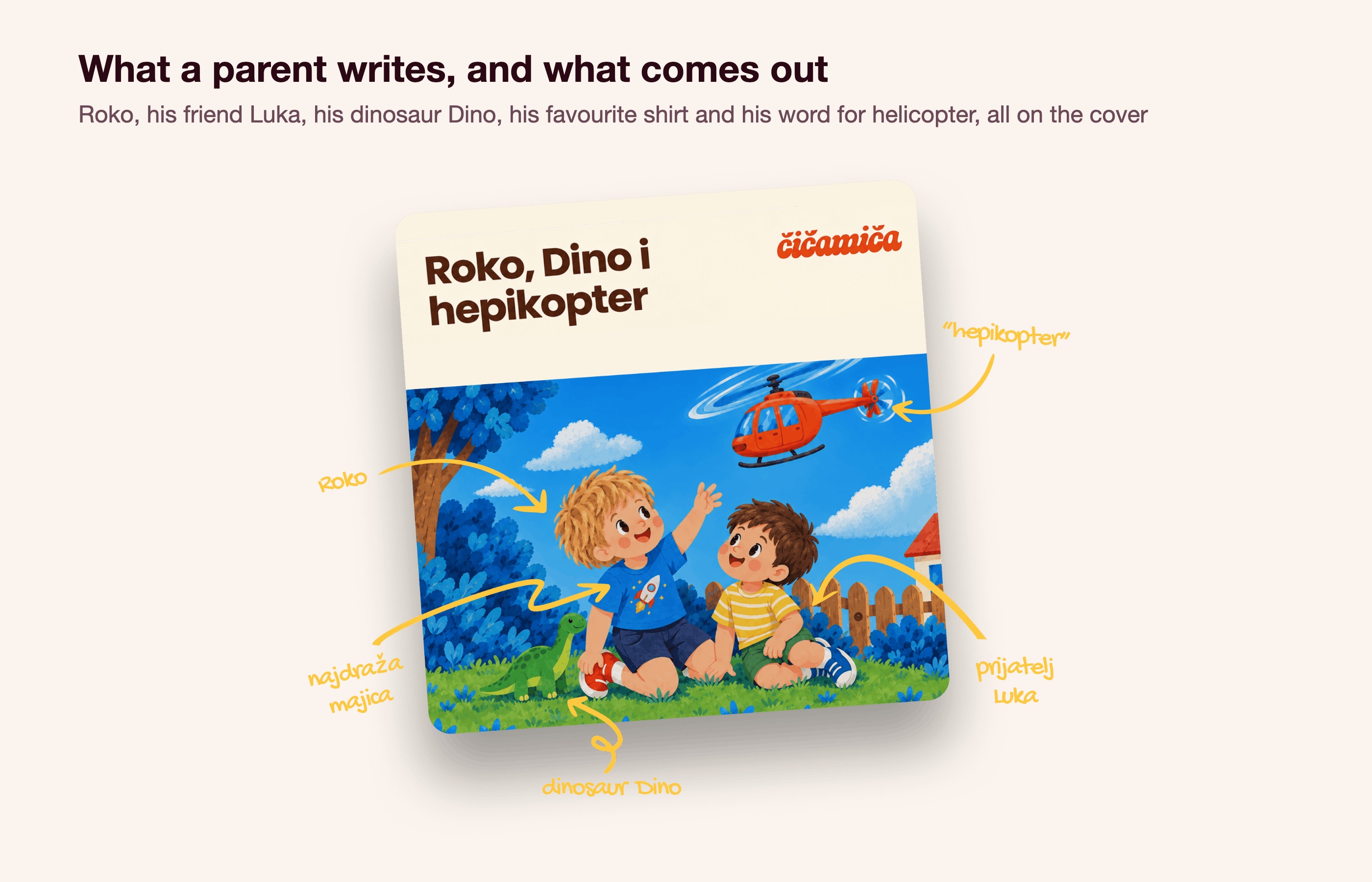
Čičamiča is a product we built at blank. Most personalised children's books are one book for everyone, with a different name dropped into the same sentences. Kids notice. We wanted a story that's really about them, with their pets, their grandparents, their favourite toys, and a real printed book at the end.
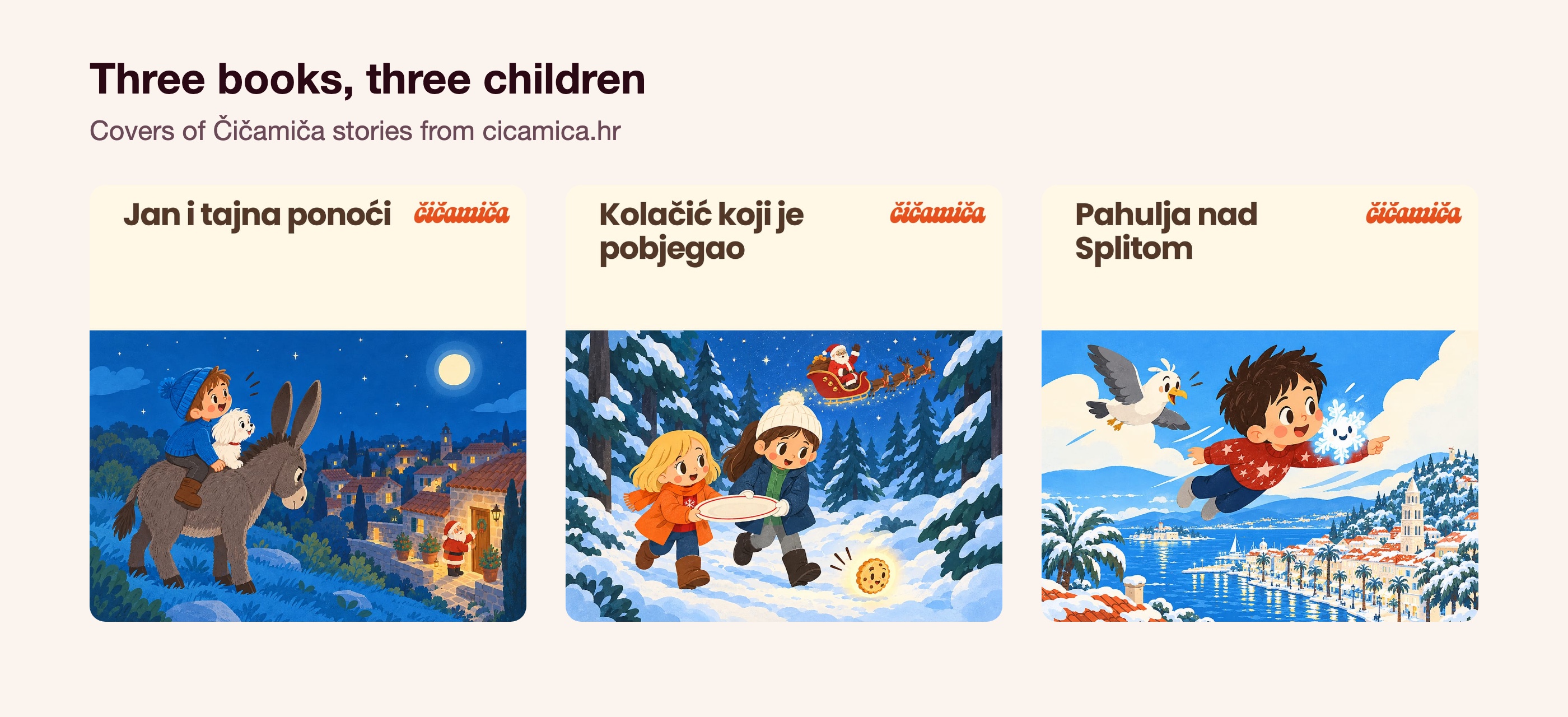
You can try it at cicamica.hr. The app and the stories are in Croatian.
What was hard to build
Asking a model for a bedtime story takes one prompt. Getting a book a parent will pay for, read aloud and keep takes a lot more. These were the hard parts.
One prompt gives you the most predictable story
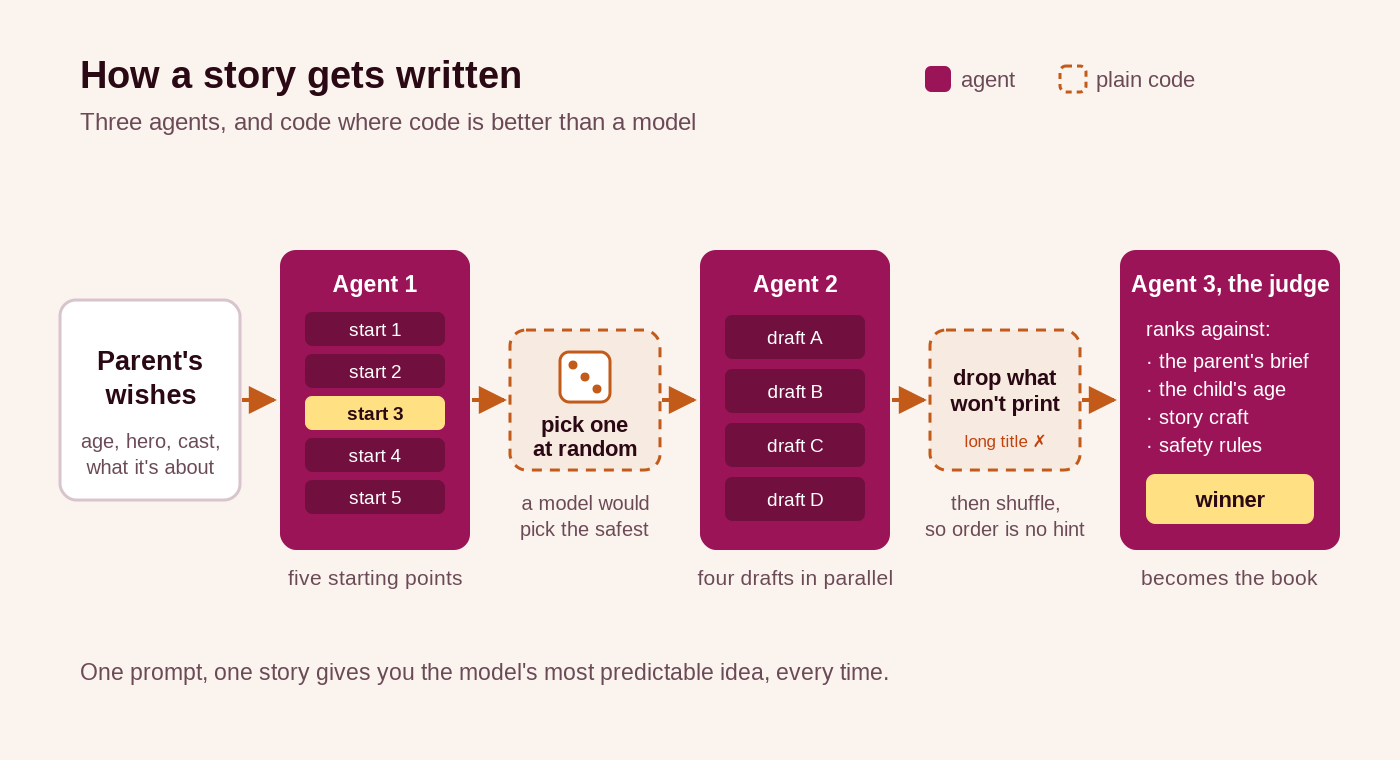
So a story is written in stages, by three agents.
The first agent reads the parent's wishes and proposes five different starting points. Then the code, not the model, picks one at random. When a model chooses, it picks the safest option, and randomness is what keeps the stories surprising.
A second agent writes four complete drafts of that story in parallel, sized for the child's age. Plain code throws out drafts that wouldn't print well, like a title too long for the cover. Then a third agent, the judge, ranks the drafts, shuffled so their order is no hint, against the parent's brief, the age, how a good story is built and the safety rules. The best one becomes the book's text.
The same world on every page
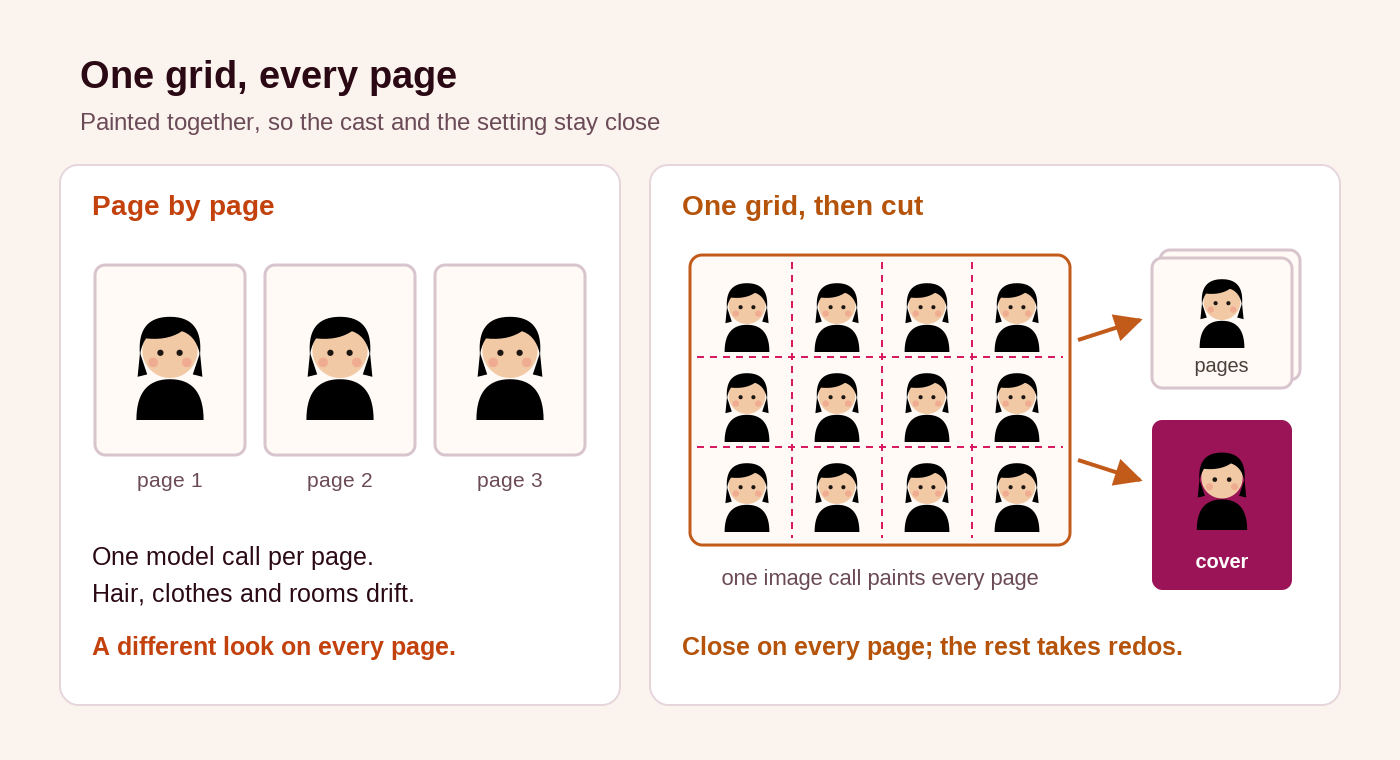
This was the hardest problem. Image models are good at keeping a character consistent, until they aren't. Halfway through a book the hair, the shirt or the face can change, even when you give the model reference images. The setting is just as hard. If the story happens in the living room, you want the same sofa, the same window and the same rug on every page, and in most cases models just don't get it.
So we stopped painting pages one by one. The story is finished before any picture exists, and a separate planning step, not one of the three story agents, decides how the text splits into pages and what each picture shows. Then a single image model call paints every page together, as one grid, and the pages are cut out of it. Because they were painted together, the cast, the palette and the setting stay very close across the whole book. The cover is painted afterwards, with the grid as its reference, so the child on the front is the child inside.
Then the book checks itself. Another model looks at the grid for three things only: a character who doesn't look like themselves, something physically impossible, or a broken panel. One more call repairs those pages, and anything still wrong is flagged for a person.
With one grid the scene stays almost the same on every page. Making it fully the same still takes a few redos, and sometimes a manual fix.
I expect upcoming models to fix most of this, and every improvement there only makes Čičamiča better.
Her name, in seven cases
Croatian changes names by case. Petar becomes Petra, Petru, Petrom. So before the story is written, the parent sees the child's name in all seven cases, each in a short example sentence, and can fix any of them. Families don't all say names the same way, and the book should sound like home.
Safe and right for her age
A three-year-old and an eight-year-old need very different stories, and whatever a parent types in, the story has to be safe for a child. The age band shapes every draft, and the judge checks the safety rules.
People have the last word before print
Before the printed book is made, parents can read it, edit the text and send feedback on any page. Our team reviews every change a parent asks for before the print version. They can redo or edit a single page, repaint the cover, or repaint the whole grid with a note, and then send the updated book back.
The right model for each part
Behind the scenes, the engine uses several models from Anthropic, Google and OpenAI. Each one does the part it's best at. We didn't guess which is which: we tested them and kept what worked best for our case.
What I took from it
The model isn't the product. The product is everything around it: the stages that turn one prompt into a good story, the trick that keeps every page looking like the same world, the checks that keep it safe, and the people who have the last word.
And the best review so far is a little girl on the sofa, reading a book about a sparrow that nobody else in the world has.